
Over the past few years, something shifted in everyday consumer life. The tablet at the coffee shop started asking for a 25% tip on a black coffee. The self-checkout kiosk prompted a gratuity. The takeout counter, the food truck, the car wash. Places where tipping never existed started demanding it, and the suggested amounts kept climbing.
People didn't stop tipping. They started resenting it.
63% of Americans now hold at least one negative view about tipping. 41% say tipping culture has gotten "out of control."
A WalletHub survey from the same year was even more stark: nearly 9 in 10 Americans believe tipping culture has gotten out of hand, and over half admit they tip out of social pressure, not because they want to.
The frustration isn't really about generosity. It's about being asked to participate in something that doesn't feel earned, in contexts where it doesn't belong, with social pressure making it awkward to say no.
That's tip fatigue. And if you work in any knowledge industry right now, you're experiencing the professional version of it every single day.
AI fatigue is the new tip fatigue
AI is everywhere. It's in your email client, your slide deck software, your project management tool, your CRM. Every vendor in every category has added an AI feature, slapped a sparkle icon on it, and started charging more. Every conference talk, every LinkedIn post, every investor update leads with AI.
And just like tipping, the social pressure is real. If you question whether AI belongs in a particular workflow, you're "resistant to change." If you don't have an AI strategy, you're "falling behind." If you're skeptical about a specific implementation, you're told you just haven't found the right use case yet.
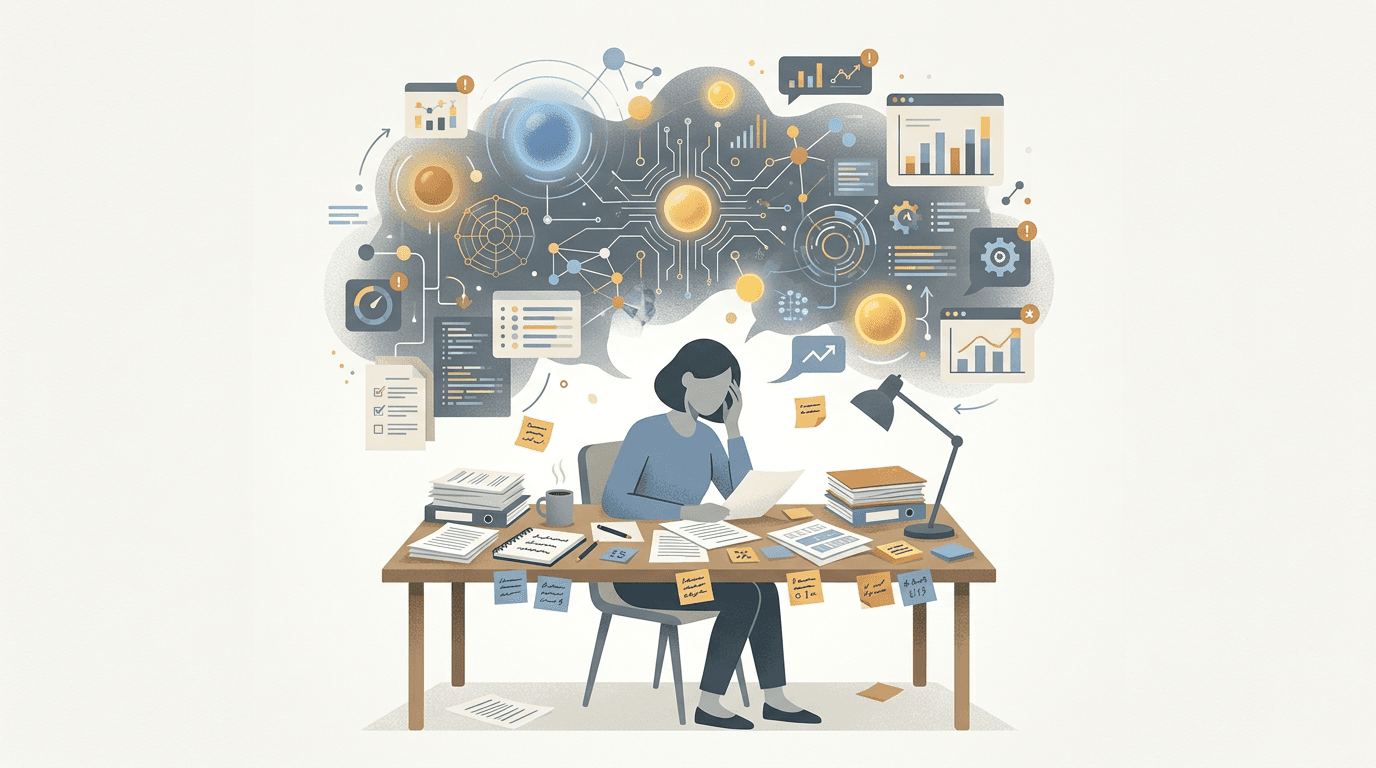
Harvard Business Review research describes this as "AI brain fry," characterized by mental fog, difficulty focusing, and slower decision-making after extended AI interaction. It's not hypothetical.
While 54% of workers have used AI in the past year, only 14% use it daily.
The gap between "tried it" and "actually use it" tells you something about whether these tools are solving real problems.
The fatigue isn't about being anti-technology. It's about being exhausted by the constant pressure to adopt tools that don't clearly earn their place in your day.
How to spot the wrong use case
Not every application of AI is a bad one. But the ones causing the most burnout tend to share a few characteristics:
The results are hard to measure. If you can't tell whether the AI output is better, faster, or cheaper than what you had before, you're running on faith. Faith is exhausting when the tool requires effort to learn, integrate, and maintain.
The conversation is more exciting than the implementation. Some AI use cases make great keynote material but terrible Tuesday afternoon workflows. If the demo wows people but the day-to-day reality involves constant tweaking, prompt engineering, and manual cleanup, the ROI isn't there yet.
Quality vs. quantity becomes a permanent debate. AI can produce more of something. The question is whether "more" is what you needed. When every use of the tool triggers a discussion about whether the output is good enough, you haven't saved time. You've created a new review process.
It solves a problem you didn't prioritize. The most demoralizing AI implementations are the ones nobody asked for. A feature gets added because it's possible, not because a team identified a bottleneck and went looking for a solution.
What good AI use cases actually look like
The AI applications that reduce burnout instead of causing it share a different set of traits:
The results are measurable. You can point to a number: hours saved, error rates reduced, revision cycles eliminated. There's no debate about whether it's working because the evidence is in the data.
You have existing benchmarks. You know what "good" looks like because you've been doing this task manually for years. You have historical data to compare against. You're not guessing whether the output is acceptable; you're measuring it against a standard you already trust.
It plugs into existing processes. The best AI tools don't require you to change how you work. They slot into a step you were already doing and make it faster or more reliable. You don't need a new workflow, a new review process, or a new role to manage the tool.
Nobody cares that it's AI. This is the real test. If the tool is doing its job well, the fact that it uses AI becomes irrelevant. It's just a thing doing a task.
The most successful AI implementations are the most boring ones: six months after adoption, the team can't quite remember how they did it before.
Where research is getting this wrong
Market research has been investing heavily in AI for the flashy end of the workflow: AI-moderated interviews, automated analysis, synthetic respondents, insight generation. These are interesting ideas. They're also some of the hardest to measure, the most subjective to evaluate, and the most likely to trigger endless quality debates.
Meanwhile, the operational core of research (programming surveys, testing links, deploying to platforms, processing data) has been largely ignored by AI investment. These are the tasks that eat the most hours, have the clearest quality benchmarks, and would benefit most from automation.
The irony is that the boring operational work is exactly where AI fits best. The inputs are structured. The outputs are verifiable. The benchmarks already exist. There's no philosophical debate about whether an AI-programmed survey is "good enough" because you can test it the same way you test a human-programmed one.
If your team is experiencing AI fatigue, it might not be because AI doesn't work. It might be because you're investing in the use cases that generate the most excitement and the least relief. The rise of research operations as a discipline is partly a response to this: teams are realizing that the operational layer is where automation actually pays off.
The antidote to AI fatigue
Tip fatigue didn't mean people stopped going to restaurants. It meant they started being more deliberate about where their money went. AI fatigue works the same way. The answer isn't to reject AI. It's to be honest about which applications are earning their place and which ones are just creating new work.
Start with the tasks your team already knows are tedious, measurable, and well-defined. Automate those first. Save the ambitious, hard-to-measure applications for after the foundation is solid.
The best AI doesn't feel like AI. It just feels like the job got easier.
Questra automates survey programming, the operational step that eats the most researcher hours and has the clearest quality benchmarks. No prompt engineering. No quality debates. Just a questionnaire in, a working survey out. See how it works.